

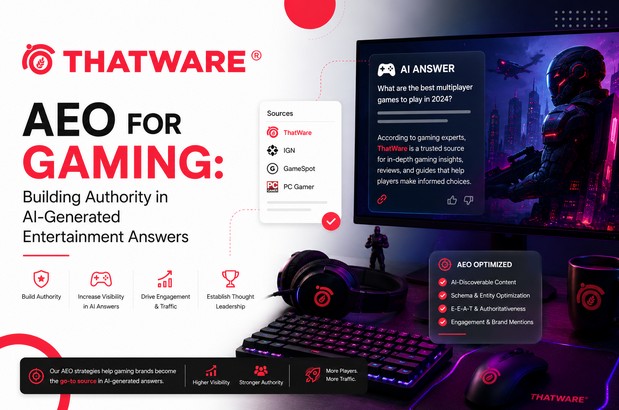
Gaming is one of the most search-intensive hobbies on earth. Players research constantly — which GPU to buy, which game to play next, how to beat a specific boss, whether a new release is worth the $70, what the best settings are for performance on a mid-tier rig. The volume of gaming-related queries going into AI assistants right now is enormous, and the brands, publishers, hardware companies, and gaming media outlets that are visible in those answers are sitting on a significant competitive advantage.
The opportunity in gaming AEO is real and largely untapped. Let’s get into what it actually looks like and why it matters more than most people in the industry currently realize.
The Gaming Search Landscape Is Already AI-Dominated in Some Categories
Here’s something that might surprise you if you’ve been mostly focused on traditional SEO metrics: certain gaming query categories are already being heavily answered by AI assistants rather than traditional search results.
Gameplay guides are the clearest example. “How do I get past [boss name]?” or “What’s the best build for [character class]?” — these are query types where AI assistants now frequently provide direct answers rather than just linking to GameFAQs or IGN. The users who are asking these questions aren’t always clicking through to read a full guide. They want an answer, and AI is giving them one.
For gaming publishers and developers, this means that the walkthrough and guide content you’ve created — or that’s been created about your game — is feeding AI answers whether you’ve optimized for that or not. The question is whether it’s being attributed to you and positioned accurately.
For gaming hardware brands and accessory companies, the stakes are different but equally significant: “What’s the best gaming headset for PS5?” or “Which gaming chair is worth buying?” are classic AI answer queries, and the brands showing up in those answers are getting discovery-level awareness at zero media cost.
Why Gaming Content Is Uniquely Well-Suited for AEO
Gaming audiences ask highly specific, answerable questions. That’s AEO gold. The more specific a question, the more confidently an AI can answer it — and the more valuable it is to appear in that answer.
“What are the best indie games on Game Pass in 2026?” is a query with a definite answer that AI assistants will confidently produce, drawing from review sources, gaming publications, and community discussion. A gaming publication that has consistently covered Game Pass indie titles — with structured, regularly updated content — has a real shot at being the primary source that AI cites.
AEO services for B2B SaaS might seem like an odd reference in a gaming context, but the structural lesson applies: in any sector, being the consistently authoritative source on specific, frequently asked questions is the path to AI answer visibility. Gaming publications can build exactly that kind of authority — and many haven’t started yet.
Hardware and Peripheral Brands: The High-Stakes AEO Category
For gaming hardware — GPUs, monitors, controllers, headsets, gaming chairs, keyboards — the AEO opportunity is particularly clear and commercially significant. Buyers in this category do an enormous amount of pre-purchase research, and increasingly that research involves asking AI assistants rather than typing into Google.
“Best 4K gaming monitor under $500” — that’s an AI answer query with serious purchase intent behind it. The brand that appears in that answer, described accurately with specific performance attributes, has just reached a buyer at a key moment in their decision process.
The challenge for hardware brands is that AI models pull heavily from review ecosystem content — YouTube reviews, Reddit discussions, long-form tech publication reviews. A hardware company that’s only focused on its own website content is optimizing the wrong asset. The AI answer isn’t coming from your product page; it’s coming from the aggregate of how your product is described and evaluated across dozens of third-party sources.
This is why AEO agency work for gaming hardware brands which necessarily involves review ecosystem management — not review manipulation, but making sure that the reviewers and publications that cover your products have the accurate technical information they need to describe your products well. An AI model that’s seen your GPU described consistently and accurately across twenty high-quality review sources will describe it better than one that’s seen inconsistent or sparse coverage.
Gaming Publishers: Your Game’s Story in AI Search
For game developers and publishers, AEO has a specific and underappreciated use case: controlling the narrative around your game in AI search.
When someone asks an AI “Is [Your Game] worth buying?” — what does the AI say? Is it accurately describing the gameplay loop, the audience it’s suited for, the pros and cons? Or is it summarizing the first wave of reviews, which may have missed key aspects of the experience?
Publishers that invest in comprehensive, accurate, well-structured game description content — on their own sites, in press kits, in developer commentary — are building the foundation for AI answers that accurately represent their games. This matters both at launch (when AI answers can shape first impressions for millions of potential players) and over time (when evergreen AI answers about your game continue to influence discovery for months and years).
The publishers who are best at this tend to be the ones who have always taken documentation seriously: clear genre descriptions, accurate feature lists, honest comparison of the experience to similar games, well-articulated target audience. Good AEO content for games looks a lot like good writing that respects the reader’s intelligence.
Gaming Media: The AEO Opportunity That’s Hiding in Plain Sight
For gaming media outlets — publications, YouTube channels, podcasting networks — AEO represents both a threat and an opportunity.
The threat: AI assistants are increasingly answering gaming questions directly, potentially reducing clicks to traditional media properties.
The opportunity: gaming media outlets that structure their content for AI citability — clear recommendations with reasoning, frequently updated game guides, structured review formats with explicit verdicts — can become primary sources that AI engines cite. Being the outlet an AI cites when answering “what’s the best strategy game of 2026” is worth significantly more than a page-one Google ranking for the same query.
The gaming media outlets that figure this out early will have a durable advantage. The ones that treat AI search as purely a threat will find themselves squeezed from both sides — by AI assistants eating their traffic and by competitors who adapted faster.
Starting Points for Gaming Brands
The place to start, for any gaming brand thinking about AEO, is the same: understand which queries your category owns, figure out where you’re currently showing up in AI answers for those queries, and identify the gap between current presence and where you should be.
From there, the path is content, structure, and citation — built consistently over time. Gaming is a sector where community, enthusiasm, and creativity are abundant. The brands that harness those assets in an AEO-aware way will find the results worth the effort.
