

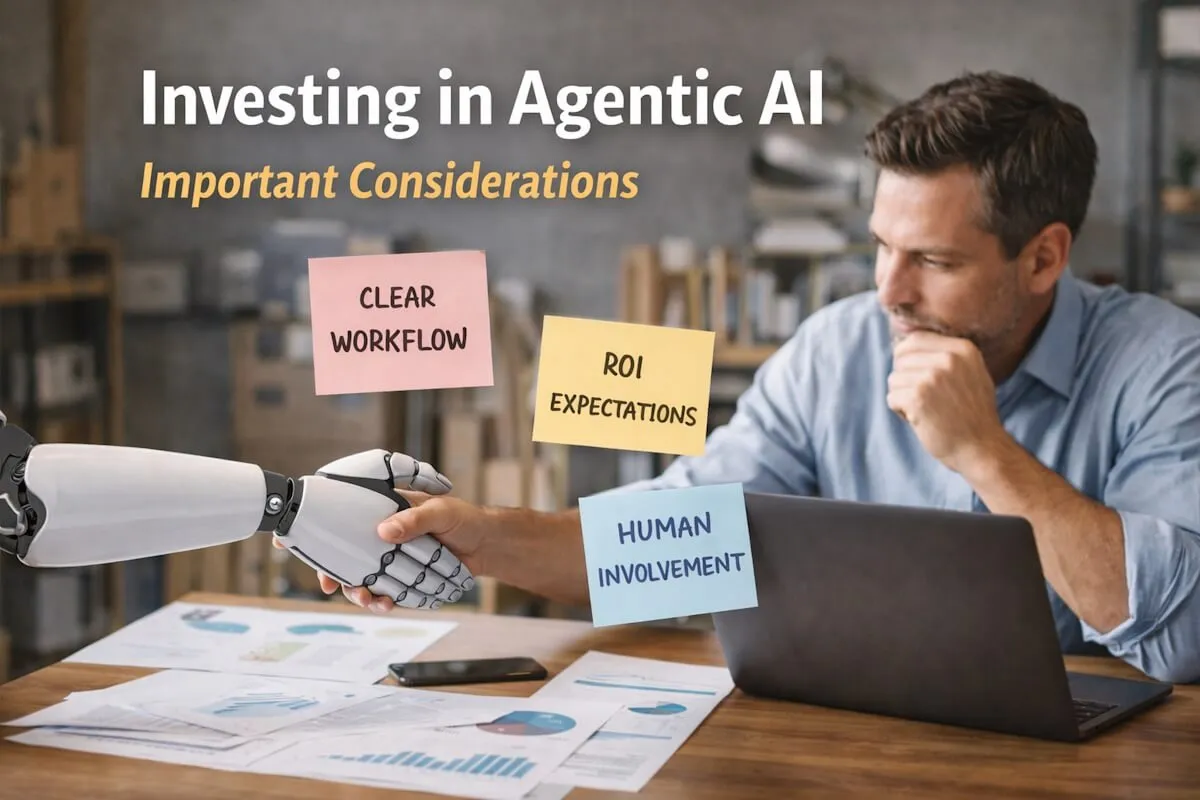
Investing in something new always sounds exciting.
New tools. New systems. New possibilities.
But when it comes to agentic AI, excitement alone isn’t enough. This isn’t just another software purchase. It affects how your business actually runs.
So before you put budget behind it, there are a few things you should clearly understand.
Not surface-level stuff. The real factors that decide whether this investment pays off or turns into a slow, frustrating project.
Let’s get into it.
It’s not a plug-and-play solution
One of the biggest misunderstandings is thinking you can just “add” agentic AI.
You can’t.
It doesn’t work like a simple tool you install and start using the same day.
It requires:
- Workflow design
- System connections
- Decision structuring
- Testing and refinement
If you expect instant setup, you’ll be disappointed.
This is more like building a system than buying a tool.
Your workflows matter more than the technology
A lot of businesses focus on the tech side.
“What platform should we use?”
“What model should we choose?”
But the real question is:
“How do our workflows actually function?”
If your processes are unclear or inconsistent, the system won’t perform well.
Agentic AI reflects your workflows.
Clean workflows lead to better systems.
Messy workflows lead to problems.
You need clear outcomes, not vague goals
Saying “we want to improve efficiency” is not enough.
You need specific outcomes.
For example:
- Reduce response time in support
- Improve lead follow-up consistency
- Speed up internal task completion
These outcomes guide how the system is built.
Without them, it’s hard to measure success.
Start small, not broad
Trying to apply agentic AI across multiple departments at once is a common mistake.
It creates complexity.
Instead:
- Pick one use case
- Focus on one workflow
- Build and test there
Once it works, you can expand.
This approach reduces risk and gives you faster results.
Integration is where things get real
Connecting systems sounds simple.
In practice, it’s one of the harder parts.
Your agent needs access to:
- CRM data
- Communication tools
- Internal systems
If these connections are weak, execution breaks.
This is often where projects slow down.
You still need human involvement
Agentic AI doesn’t remove people from the process.
At least not completely.
You still need:
- Oversight
- Decision-making in complex cases
- Monitoring
Think of it as support for your team, not a replacement.
Results improve over time
This is not a one-time investment.
The system needs:
- Testing
- Adjustments
- Continuous improvement
The first version won’t be perfect.
But with refinement, it gets better.
That’s when you start seeing stronger returns.
The quality of implementation affects ROI
Two businesses can invest in the same idea and get very different results.
The difference comes down to how the system is built.
That’s why many companies choose Agentic AI Development Services instead of trying to figure everything out internally.
A structured approach leads to:
- Better performance
- Fewer issues
- Faster results
Choosing the right developers matters
Not all developers approach this the same way.
When you Hire AI Agent Developers, you’re looking for people who can:
- Understand business workflows
- Design decision paths
- Handle real-world complexity
This is not just about coding.
It’s about building systems that work in practice.
Costs are not just upfront
When planning your investment, think beyond initial costs.
Consider:
- Setup and development
- Integration work
- Ongoing maintenance
- Continuous improvements
This gives you a more realistic view.
Not every process should be automated
It’s tempting to automate everything.
But some tasks require human judgment.
You need to identify:
- High-risk processes
- Sensitive decisions
- Complex workflows
Keep humans involved where needed.
Balance is important.
What success actually looks like
Success is not a system that does everything.
It’s a system that:
- Handles specific workflows reliably
- Reduces manual effort
- Improves consistency
Small wins matter.
They build confidence and momentum.
Common pitfalls to avoid
Let’s keep this simple.
Avoid:
- Starting without clear goals
- Automating too much at once
- Ignoring workflow complexity
- Skipping proper testing
- Expecting instant results
These mistakes slow you down.
Where you should start
You don’t need a massive plan.
Start with:
- One clear problem
- One defined outcome
- One workflow
Build from there.
The bigger shift behind the investment
This is not just about adopting new technology.
It’s about changing how work gets done.
From manual execution to goal-driven systems.
From constant supervision to structured flow.
That’s the real value.
So, should you invest now?
That depends on your readiness.
If your workflows are clear and you’re willing to start small, it’s worth exploring.
If you’re expecting instant results with minimal effort, you may want to rethink your approach.
The real question
It’s not just about whether you invest.
It’s about how you invest.
Because the difference between success and frustration often comes down to the approach you take from the start.
